 MentAI
Why would a psychologist need practice software at all? A thought experiment: the practice by candlelight
Let us run an honest thought experiment. Let all technology go dark, not just the software but the electricity too. Does therapy still work? Yes. Does the practice? That is a very different story. Along the way we explain why this profession is among the most resistant to AI, and where the fear comes from that refuses to go away anyway.
1. Turn off the power
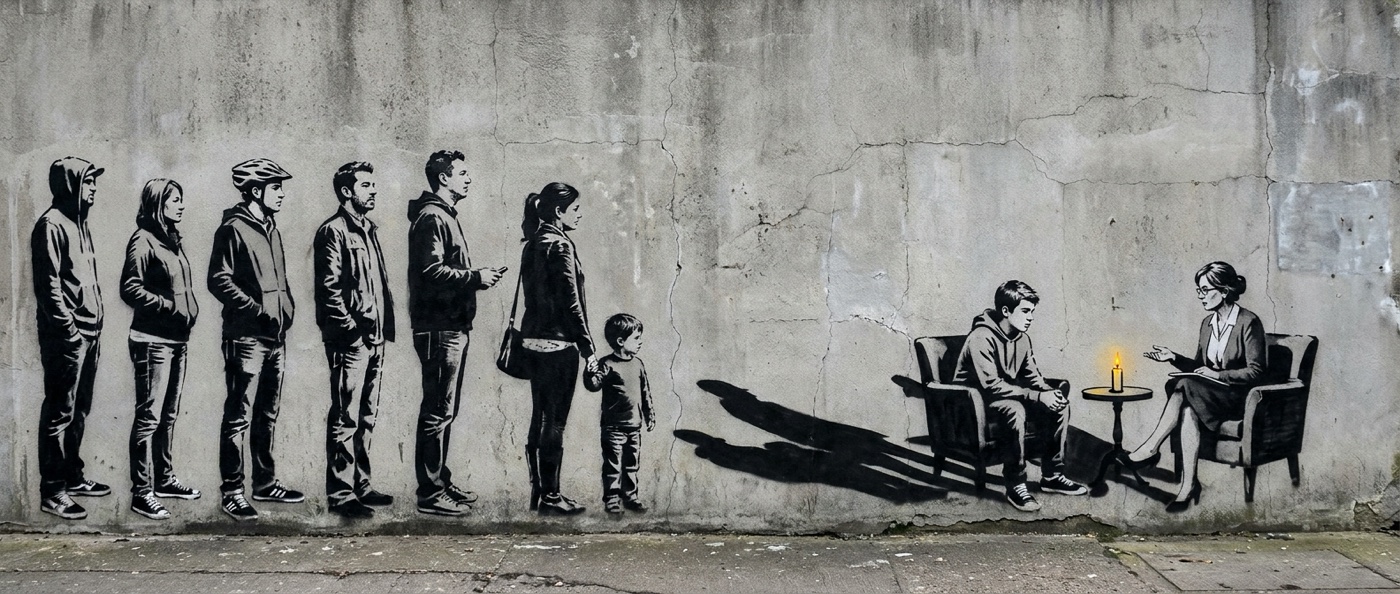
Picture an evening when everything goes out. No internet, no software, no phone. What is left in the room is an armchair, a couch, a candle and two people.
And it turns out that nothing important has disappeared. The conversation goes on. The silence after a hard question lasts exactly as long as it should. The therapist notices the client shift in the chair when the word "father" comes up. The candle gives enough light to see a face. Nothing more is needed.
This is not a rhetorical trick. It is the fact we start every conversation about technology in therapy from: no software does the therapy. A person does it, with training, supervision and professional responsibility, in a relationship with another person. Without power it works exactly as it does under fluorescent light.
If the practice ended there, this text would have no second half. But a practice does not end with the session.
2. The queue outside the door
Let us step outside for a moment. There is a queue. Nobody in it is in a session right now. There are the people who wanted to book and could not get through, because the therapist was with a client at the time. There is the person who took an appointment three weeks ago and forgot it today, because nobody reminded them. There is someone who hesitated before the next session and preferred to vanish rather than call and say so.
When there is no power, this queue has no way in. The only way to book is to be in the room at the exact moment the therapist is not working with anyone. The only reminder is your own memory. The only way to move an appointment is to come and say it in person.
The cost of this queue has two sides. On the practice side it is the empty chair at 5 p.m.: a prepared room, a reserved hour, no income, and a slot someone else would have taken on the spot (we wrote about it in the piece on no-show appointments). On the client side the cost is heavier: a person who needed help did not get it, because logistics stood between them and the chair.
In Poland this queue has a measured length. The Watch Health Care Foundation regularly checks, across roughly 1,500 facilities, how long people wait for services in the public system. In its survey from September and October 2025, a visit to a mental health outpatient clinic for a sixteen-year-old with anxiety symptoms and insomnia meant an average wait of 5.8 months, up from 5.3 the year before. Psychiatry as a whole: 2.4 months, up from 1.8. The queue is not shrinking. It is growing.
Remember it. We will come back to it when we reach artificial intelligence, because it explains the biggest misunderstanding in this whole debate.
3. The notebook
After the session, the therapist opens a notebook. The note gets written because it has to be: for continuity, for supervision, for oneself six months from now. A paper notebook has one advantage software can only dream of. It cannot be hacked over the internet.
It also has weaknesses that come back immediately in a dark room. The notebook lies in a drawer that can be opened. It does not know who has read it. There is no copy, so a fire or a flood means the end of ten years of records. And from 19 May 2028 the profession of psychologist in Poland gets a full statute with a register and professional accountability (Journal of Laws 2026, item 187; we collected the dates and articles in our piece on the Polish Act on the Profession of Psychologist (in Polish)). Responsibility for the records will not vanish with the power. It will simply fall entirely on the drawer.
A word of caution, because it is easy to overshoot the other way: the point is not for a machine to write the note. The point is where that note lives, who sees it, and whether it survives a flood.
4. The invoice
The last scene of this experiment is the least romantic. A client asks for an invoice. Without power you can write one by hand, and the law allows it, because the clients of a practice are private individuals. Only that each such invoice needs a number in an unbroken sequence, a copy, and a place where it will sit for years, until the tax limitation period runs out. A notebook of invoices is a second notebook in the same drawer, with the same weaknesses. If you want more, it is in our text on invoicing in a therapy practice (in Polish).
Notice what is happening. Therapy without power works. Running a practice without power does not, because the state, the clients and the therapist themselves expect things that happen between sessions: an appointment, a reminder, a note, an invoice. The dark did not take the therapy. It took everything around it.
5. Who is artificial intelligence in this story
Now let us turn the light back on and let AI into the conversation, because the fear of it in this profession is real. We do not reach for forecasts from a decade ago, but for three measurements from the last sixteen months, one of them computed on Polish data.
Closest to home is the International Labour Organization study from May 2025. The team led by Pawel Gmyrek and Janine Berg took 29,753 tasks from the Polish occupational classification, surveyed 1,640 people working in Poland, and rated which of 2,861 tasks generative AI can take over today. The scale runs from 0 to 1. At the top: data entry (0.70), typing (0.65), bookkeeping (0.64), financial analysts (0.62), payroll (0.61). Psychologists score 0.39 and land in the lowest of the four groups of exposed occupations, with a description worth reading twice: the occupation as a whole rests on tasks that cannot easily be automated, but a few tasks within it can be. Social workers and counsellors sit even lower, at 0.28, in the group of occupations that are not exposed.
Those "few tasks" have a name. They are the notebook, the invoice and the schedule. Not the chair.
The second measurement is the freshest and it measures facts, not potential. In March 2026 Anthropic checked, on real conversations with its Claude assistant, in which occupations people are actually handing part of their work to the machine. Highest were programmers (75 percent), customer service, data entry clerks (67 percent) and medical records specialists. Psychologists and therapists do not appear on those lists. In healthcare, what gets handed over is the paperwork, not the conversation.
The third measurement is the hardest for our argument, which is why we do not skip it. In 2025 Microsoft Research counted, across 200,000 conversations with Bing Copilot, how often activities from 785 occupations show up in chats: clinical psychologists score 0.21 against a median of 0.14 and a maximum of 0.49, that is above the middle of the pack. People ask the chatbot for what sounds like a psychologist's work: being heard, an explanation, advice. The study measures what people look for in a chat, not what a chat can do in a therapy room, and its authors themselves warn that drawing conclusions about automation of occupations from it would be a mistake.
Copilot, however, is mostly office work. What about the chats people write to privately, in the evening, about themselves? Two companies counted it on their own data. OpenAI, with economists from Harvard, reviewed 1.5 million ChatGPT conversations in September 2025: more than 70 percent of messages are not about work, but conversations about relationships and oneself make up 1.9 percent of the total. Anthropic examined 4.5 million Claude conversations in June 2025: emotionally driven conversations, from relationship advice to seeking support, are 2.9 percent, and companionship and role play below half a percent. Small in percentages. With hundreds of millions of users, though, that is millions of people a week taking something personal to a machine, because it is midnight and the machine does not make you wait five months.
Google publishes no such shares. It did something more telling instead: on 7 April 2026 it added to Gemini a button that, in a conversation suggesting a crisis, connects the user straight to a helpline, and stated plainly that Gemini is not a substitute for clinical care, therapy or crisis support. The scale of the phenomenon on the other side of the ocean is shown by a KFF poll from March 2026: a third of American adults have already looked for health information in AI chats, and one in six has asked about mental health. The biggest search company and the largest independent health research organisation say the same thing we say in this text: the queue is real, and a chat is not a therapist.
And here the queue outside the door returns. Our interpretation, not a study result: the people who talk to a chatbot about anxiety, a break-up or insomnia are, in large part, people who did not get an appointment, could not get through, or were afraid to call. The chatbot did not sit down in the therapist's chair. It talks to the people standing in the queue outside. That is not therapy and it does not replace the therapist. It is a signal that the queue is long.
The conclusion is not new: back in 2013, Frey and Osborne at Oxford placed psychologists among the 25 safest of 702 occupations, and thirteen years and two AI revolutions later, three fresh measurements say the same.
That is why every piece of software that enters a therapy practice should come with written limits. We wrote ours down in the text on five things AI in a practice should not do. The first one reads: AI does not run therapy. In the dark you see it most clearly: here is the therapist's work, and there is the logistics around it.
6. Turning the light on
Since therapy works without technology and the practice does not, the role of technology is clear and modest: take care of the queue, the notebook and the invoice, so the therapist can stay by the chair.
In practice that is four things, whatever software does them. The client books on their own, even in the middle of the night, and the therapist sees one schedule. The reminder arrives on its own and can be replied to, so hesitation turns into rescheduling rather than vanishing. The session note has a safe place, a copy and a trace of who has looked at it. The invoice is created at the visit and goes where it needs to go on its own.
That is how we see it at MentAI: we do not walk into the room with the chair, we take care of the corridor (how that looks day to day is described on our page for psychologists, in Polish).
By candlelight you can see clients. You cannot run a practice.
If you are afraid of AI, you have every right to be. But be afraid of the right thing: not that a machine will take the chair, because in this profession that is the least likely scenario of all the ones that have been counted. Be afraid of the queue, which grows when the practice runs by candlelight.
Sources: P. Gmyrek, J. Berg et al., "Generative AI and Jobs: A Refined Global Index of Occupational Exposure", ILO Working Paper 140, May 2025 (table A1, ISCO-08 2634 and 2635); Anthropic, "Labor market impacts of AI: a new measure", 5 March 2026; K. Tomlinson et al., "Working with AI: Measuring the Applicability of Generative AI to Occupations", Microsoft Research, 2025 (arXiv 2507.07935, data in the microsoft/working-with-ai repository); A. Chatterji, D. Deming et al., "How People Use ChatGPT", NBER Working Paper 34255, September 2025; Anthropic, "How people use Claude for support, advice, and companionship", 27 June 2025; Google, "Google's mental health work and support for organizations", blog.google, 7 April 2026; KFF, "Tracking Poll on Health Information and Trust: Use of AI for Health Information and Advice", survey of 24 February to 2 March 2026, 1,343 US adults; C. B. Frey, M. A. Osborne, "The Future of Employment", Oxford Martin School, 2013; Watch Health Care Foundation, "Barometr WHC, September/October 2025" (annex: psychiatry); Journal of Laws 2026, item 187. As of 18 September 2026.
Frequently asked questions
Will artificial intelligence replace psychologists or psychotherapists?
Not according to the latest measurements. The International Labour Organization (May 2025, data from the Polish occupational classification) rates generative AI as affecting psychologists to a small degree (0.39 against a peak of 0.70 for data entry) and counsellors and social workers almost not at all (0.28, the group of occupations not exposed). Anthropic (March 2026) measures where people really hand work to machines: programmers, customer service, data entry and medical records come out on top, and psychologists are not on the lists. Microsoft's 2025 data shows that people ask chatbots to talk about their problems, but the authors stress this does not mean the profession is being replaced. What can be automated is the paperwork around the practice, not the session.
Can you run a psychology practice without any software?
The therapy, yes. The practice, with difficulty. Without software the therapist answers the phone between sessions, sends reminders by hand, and keeps records and invoices in a drawer without a copy. Software does not change the session. It changes everything between sessions.
What does software change in a practice in the first week?
Four things: clients book through the practice's own page, reminders go out without the therapist's involvement, the session note has a safe place with a copy, and the invoice is created at the visit. The most honest test is your own appointments during a trial month, or a sandbox with sample data, without creating an account.